
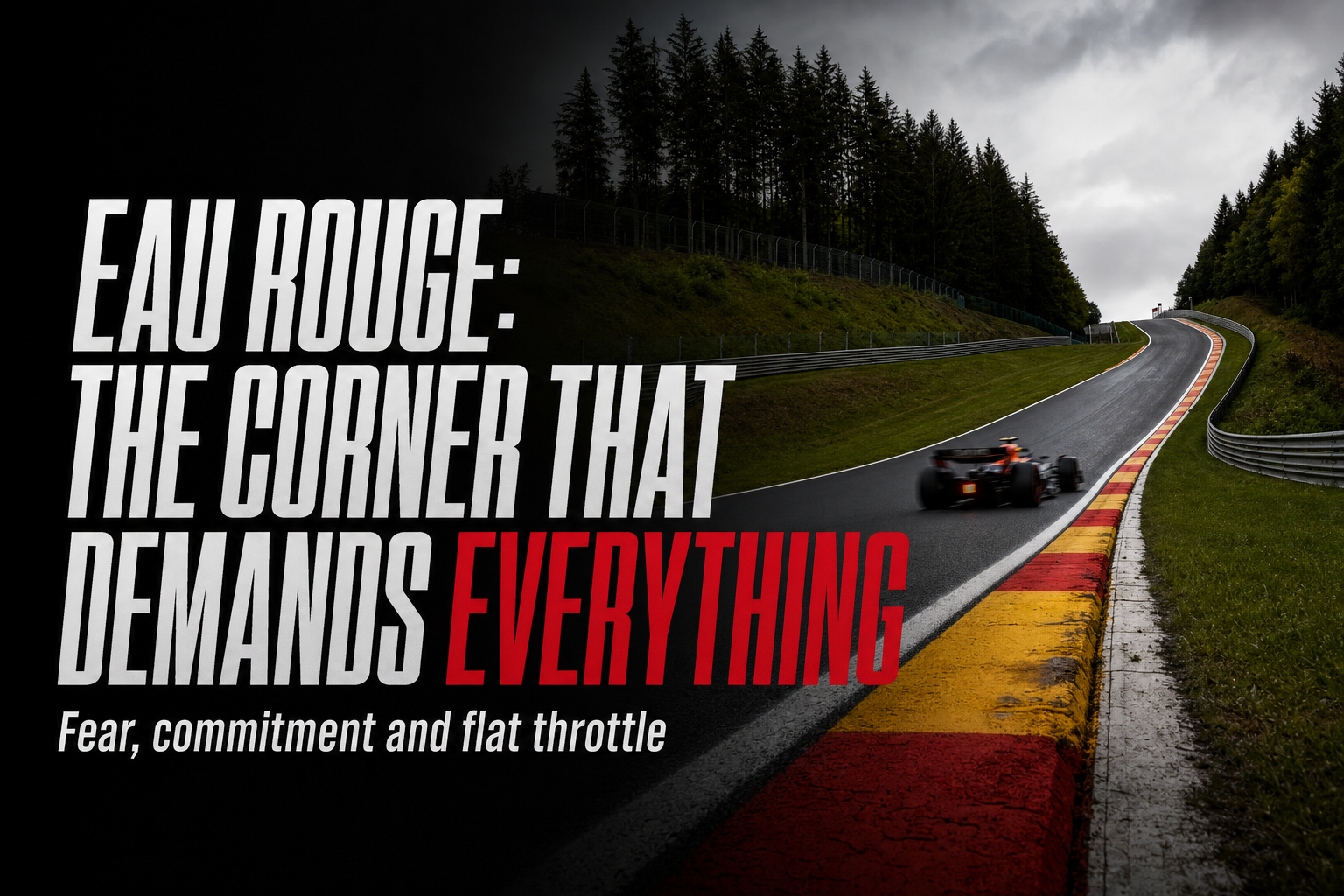

“Every lap through Eau Rouge is a leap of faith.
The Corner That Defines Courage
There are corners in Formula 1 that reward technique, there are corners that reward patience, there are corners where the right tyre compound matters more than anything the driver does, and corners where setup decisions made in the garage determine the outcome before the car reaches the apex.
And then there is Eau Rouge.
Eau Rouge, and the Raidillon that follows it immediately, is the corner combination at Circuit de Spa-Francorchamps that has defined the concept of driver commitment more completely than any other section of track in the sport’s history.
It is not the fastest corner in Formula 1, nor is it the most technically complex. What it is, and what no other corner quite replicates, is the purest test of a driver’s willingness to trust their car and their instincts at a moment when everything happening around them suggests that caution would be the reasonable response.
Understanding Eau Rouge is understanding something fundamental about what Formula 1 drivers do and what separates the best of them from the very good.
What Actually Happens
Eau Rouge begins at the bottom of a valley, where the circuit crosses a small stream of the same name after the long straight that leads from the La Source hairpin at the top of the hill. The approach is at high speed, braking from the straight into a left-right-left combination that changes direction while simultaneously climbing a steep hill.
Eau Rouge begins with the left-hand kink at the bottom of the hill before the track immediately turns right uphill into Raidillon, which then crests onto the Kemmel Straight. Although fans often refer to the entire sequence as “Eau Rouge”, the famous climb is technically Raidillon. The two are inseparable in practice, taken as a single commitment that begins at the valley floor and ends when the car crests the hill and the driver can finally see the straight ahead.
At the speeds that modern Formula 1 cars approach this section, the forces involved are extraordinary. The car generates enormous downforce in the valley where the ground effect from the track’s surface combines with the aerodynamic load of the car’s own design. As the car climbs and the angle of the road changes, that downforce shifts. The car gets lighter over the crest in a way that demands absolute precision in the steering inputs applied in the seconds before it happens.
A mistake at Eau Rouge does not unfold slowly – it happens immediately and completely, and the barriers that line the outside of Raidillon have caught cars that arrived there with no opportunity for correction.
Why Drivers Fear It
The fear of Eau Rouge is not irrational, and the drivers who express it are not being dramatic.
The combination of speed, blind cresting, and the consequences of error produces a psychological challenge that persists even for drivers who have taken it thousands of times. The muscle memory of taking it correctly exists alongside the knowledge of what happens when something goes wrong, and holding both of those things simultaneously while committing to a line at 300 kilometres per hour is a specific and unusual form of courage.
Several serious accidents have occurred at or near Eau Rouge across the circuit’s history, and the ongoing debate about whether the corner’s current configuration adequately protects drivers has produced safety modifications that have reduced but not eliminated the risk.
The drivers who describe Eau Rouge as their favourite corner, and there are many of them, are not being perverse about the danger. They are describing the specific satisfaction that comes from committing fully to something that demands everything you have and rewards you with one of the most exhilarating sensations in motorsport when you get it right.
Taking It Flat
The specific phrase associated with Eau Rouge among Formula 1 fans is taking it flat, meaning maintaining full throttle through the entire combination without lifting.
Whether taking it flat is possible has been a moving target across Formula 1’s history. In slower cars with less downforce, lifting was necessary and the bravest drivers were those who lifted the least. As downforce levels increased through the 1980s and 1990s, flat became theoretically possible and then practically achievable, before the 2022 regulation changes altered the aerodynamic characteristics again.
The significance of taking it flat is not purely about the physics – it is about the mental state required to maintain full throttle at a point where the instinct to lift is almost overwhelming, where the car is at its least predictable, and where the consequences of error are immediate and severe.
That mental state, the ability to override instinct with trust, is one of the qualities that separates Formula 1 drivers from every other category of driver in the world.
Why It Endures
Eau Rouge and Raidillon have been modified, discussed, debated, and on occasion suggested for removal from the circuit in the interest of safety. They remain, because the circuit and the sport understand that some things cannot be replaced by safer alternatives without losing something that defines the experience.
Spa without Eau Rouge would be a different circuit – a good circuit, perhaps, but not the circuit that drivers describe as their favourite on the calendar year after year, not the circuit that produces the races that the Belgian Grand Prix has historically produced.
The fear and the beauty of Eau Rouge are the same thing – remove one and you lose the other.
Formula 1 has understood, so far, that the loss would be too great.
The History Behind the Name
Eau Rouge takes its name from a small stream that runs beneath the circuit at that point, the Reau Rouge, which translates loosely from French as “red water.” The reddish tint of the water comes from iron oxide in the local soil, and the stream has flowed through the Ardennes valley long before a racing circuit existed anywhere near it. The corner complex itself has been part of the Spa-Francorchamps layout since the circuit was first established in the early 1920s, though the road configuration and surface have changed considerably over the decades.
Technically, what most people call Eau Rouge is actually two corners working together. Eau Rouge is the left-handed compression at the bottom of the descent, and Raidillon is the right-handed climb that immediately follows. Drivers and commentators have used “Eau Rouge” as shorthand for the entire sequence for so long that the distinction has largely been lost in popular usage. The circuit underwent a significant redesign in 1979 and again after a series of serious accidents in the early 1990s, with the run-off areas and barriers around the complex substantially upgraded. A further round of safety modifications followed in 2021 after a multi-car incident at the start of a rain-affected race highlighted ongoing concerns about visibility and drainage on that section of the track. The name, however, has remained constant throughout every revision.
What Makes High-Speed Corners Uniquely Dangerous
The physics of a high-speed corner differ from a slow one in ways that are not immediately obvious. At low speed, a driver who runs wide or loses grip has time to react and the forces involved are relatively manageable. At high speed, the margin between a controlled exit and a serious accident compresses to fractions of a second. Lateral g-forces at Eau Rouge can exceed 4g through the compression, meaning a driver’s effective body weight quadruples momentarily. Neck muscles, which are already heavily trained in Formula 1 drivers, are working at their limit just to keep the head stable enough to see the apex.
Aerodynamic load plays a central role in why modern cars can take the corner flat at all. Downforce pushes the car into the tarmac, increasing tyre grip beyond what the car’s weight alone would generate. The problem is that downforce is sensitive to ride height, yaw angle and the turbulent air left behind by another car. A driver following closely through Eau Rouge receives disrupted airflow over their own wings, reducing downforce at precisely the moment maximum grip is needed. This is why overtaking attempts through the complex are so rare and so scrutinised when they do occur. Any mechanical issue, a loose front wing, a slow puncture or a software anomaly affecting the differential, becomes exponentially more consequential when it occurs at speeds approaching 300 kilometres per hour on a cambered, undulating surface.
