
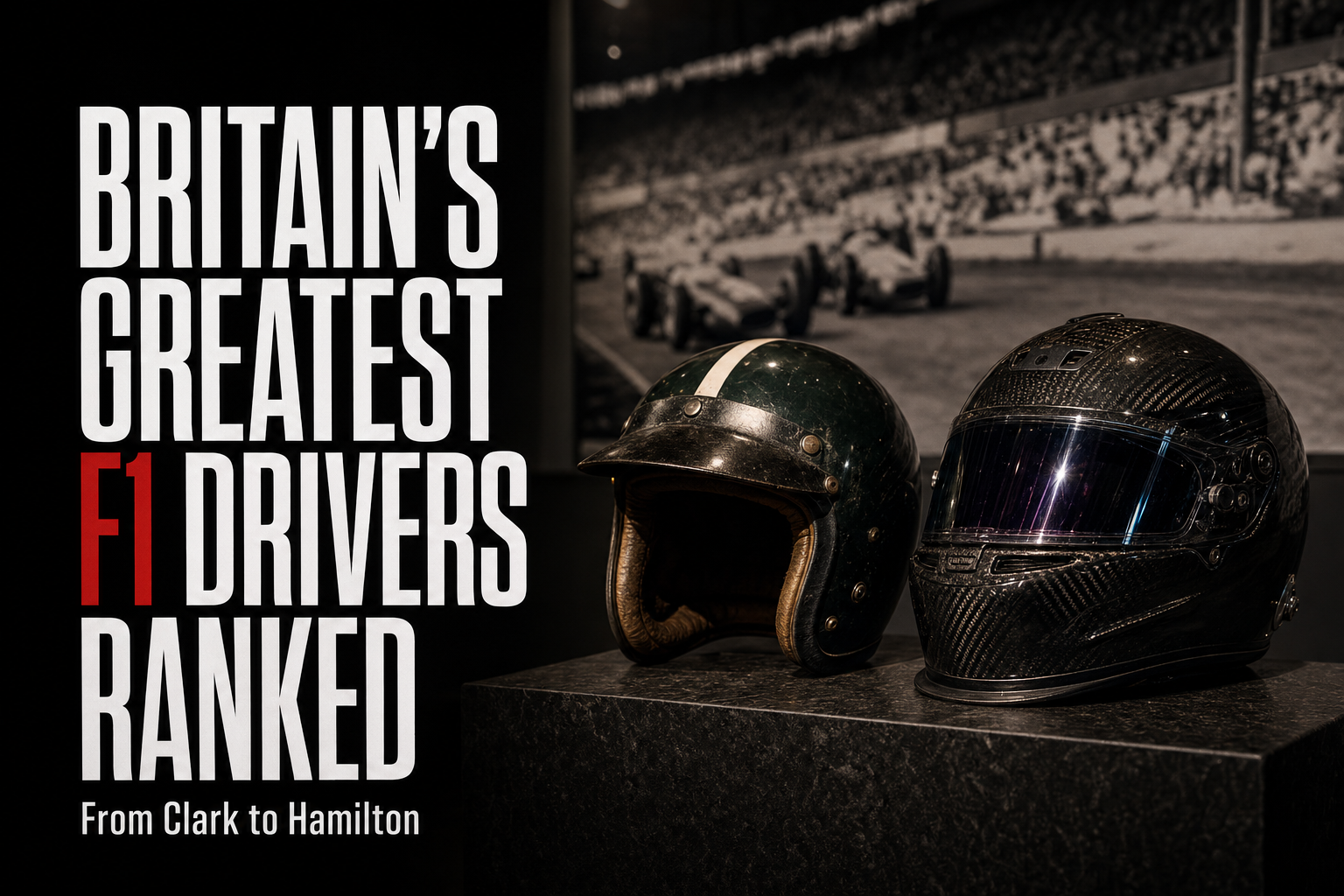

“The greatest competitor I ever raced against was Jim Clark.
The Most Successful Nation in Formula 1 History
No country has produced more Formula 1 World Champions than Great Britain.
From Mike Hawthorn’s title in 1958 to Lewis Hamilton‘s seventh in 2020, British drivers have won the Drivers’ Championship more times than any other nationality, a record built across seven decades and a roster of drivers whose diversity of style, personality and era makes comparison both difficult and irresistible.
Ranking them requires choosing criteria, because the championships, the wins and the pole positions do not tell a complete story when the cars, the eras, and the competition involved were so different.
What follows is a ranking based on a combination of statistical achievement, the quality of the competition faced, the evidence of ability beyond results- along with the overall contribution to the sport’s history.
1. Lewis Hamilton
The case for Hamilton at the top of any ranking of British drivers requires almost no argument – the argument that does exist is about whether he belongs at the top of any ranking of Formula 1 drivers regardless of nationality.
Seven world championships, one hundred and four race wins, one hundred and four pole positions.
Records that stood for years until he broke them himself – a career spanning three distinct regulatory eras, in each of which he demonstrated the adaptation and consistency that champions require without the dominance of machinery always being sufficient to explain what he achieved.
His 2007 debut season, in which he came within a point of the championship in his first year in Formula 1, remains one of the most remarkable introductions to the sport any driver has produced. His ability to perform at the highest level across fifteen years of competition, in conditions ranging from absolute dominance to genuine adversity, places him beyond ranking in any conventional sense.
2. Jim Clark
Clark’s ranking at number two is not a concession to the claims of other drivers but a recognition that Hamilton‘s statistical record, produced over a longer career in a sport with more races, is simply larger.
What Clark produced in his era, two championships in 1963 and 1965, twenty-five race wins from seventy-two starts, a win rate of 34.7% that remains among the highest in the sport’s history, was achieved against the best competition his generation produced and in cars that demanded from their drivers what modern machinery has largely engineered away.
His death in a Formula 2 race at Hockenheim in 1968 ended a career that everyone who watched him believed had further peaks to reach. The question of where Clark would rank had he lived to compete through the 1970s is unanswerable, but the drivers who raced alongside him provided a consistent answer to the question of who was fastest in the 1960s.
3. Jackie Stewart
Stewart’s three championships in 1969, 1971, and 1973 were won against competitive fields in an era when the sport’s mortality rate made every race weekend a specific kind of test that modern Formula 1 does not replicate.
His contribution to Formula 1 safety, pursued in the face of significant resistance from elements of the sport who considered his campaigning disloyal to the sport’s traditions, has saved lives that cannot be counted precisely but number in the dozens at minimum. The circuits that were modified, the safety infrastructure that was improved, the attitude toward driver welfare that shifted partly as a result of Stewart’s campaigning, all represent an achievement that exists alongside his three championships rather than separate from them.
As a driver, his smoothness and precision were the qualities that contemporaries and engineers described most consistently, a style that extracted maximum performance from a car whilst minimising the wear and stress that harder drivers inflicted on their machinery.
4. Nigel Mansell
Mansell’s 1992 championship was won with a dominance that the Williams FW14B’s active suspension advantage partly explains but does not fully account for. His ability to translate the car’s theoretical performance into actual lap time, his aggressive racecraft in wheel-to-wheel situations, and the specific quality of his relationship with the British crowd placed him in a category of sporting celebrity that few Formula 1 drivers of any nationality have occupied.
His 1986 and 1987 seasons, where championship defeats in the final races were as much the product of misfortune as of being outdriven, suggest a career that, in a different world, would have contained more than one title. What it contained instead was a level of engagement between a driver and a crowd that the sport has rarely replicated.
5. Mike Hawthorn
Hawthorn’s 1958 championship, the first won by a British driver, was decided by a single point over Stirling Moss in circumstances that included Moss’s sporting gesture of supporting Hawthorn’s appeal against a disqualification that would have cost him the title.
His death in a road accident in January 1959, three months after winning the championship, ended a career whose peak may not yet have been reached. His place on this list is earned by the championship and by the quality of his performances against the era’s best competition.
The Honourable Mentions
Jenson Button’s 2009 championship with Brawn GP, Damon Hill’s 1996 title, and the careers of Stirling Moss, who never won a championship despite being considered by many contemporaries as the fastest driver of his era, all deserve acknowledgement in any discussion of British Formula 1 achievement.
Moss’s absence from the championship winners’ list is one of the sport’s great historical anomalies, a driver whose ability was acknowledged by everyone who raced against him and who was denied the title by a combination of misfortune and, on at least one occasion, his own sporting conduct.
What the Record Means
Britain’s dominance of Formula 1’s championship history is not coincidental. It reflects a motorsport culture, an engineering infrastructure, and a racing heritage that has produced talent, teams, and technology at a rate that no other country has consistently matched.
The drivers on this list are the most visible expression of something that runs deeper than individual achievement, a national relationship with motor racing that has shaped the sport itself as much as any of the results that relationship has produced.
How the World Drivers’ Championship Actually Works
The Formula One World Drivers’ Championship has been awarded since 1950, but the points system behind it has changed more times than most fans realise. The current structure awards 25 points for a win, 18 for second and 15 for third, tapering down to a single point for tenth place. A bonus point is also available for the fastest lap, provided the driver finishes inside the top ten. This format has only been in place since 2019, and before that the sport cycled through several different models, including a nine-point maximum for a win that persisted for decades.
Crucially, the championship is decided by the individual driver, not the constructor. A driver earns points regardless of which team built the car, which is why a driver who switches teams mid-career can accumulate titles across very different machinery. The Constructors’ Championship runs in parallel but is a separate competition entirely, with points scored by both drivers at a team combining toward that tally. Ties in the Drivers’ Championship are broken by countback, meaning the driver with more race wins takes precedence, then second-place finishes, and so on. It’s a system that rewards consistency across a full season rather than a handful of spectacular results, which is why the points leader after the opening races rarely tells the full story of where a title fight is actually heading.
Britain’s Unusual Depth in Motorsport: Why It Produces So Many Champions
Britain’s outsized contribution to Formula One is not accidental. The country developed an exceptionally dense motorsport infrastructure in the decades following the Second World War, centred largely on the former RAF airfields of the English Midlands and Home Counties. Silverstone, Brands Hatch and Goodwood gave young drivers accessible venues to develop their craft, while a network of club racing series provided a competitive ladder that was genuinely open to talented drivers without enormous financial backing. This grassroots structure fed talent upward in a way that few other countries could match at the time.
Equally important is the concentration of Formula One’s technical base in Britain. The majority of teams on the grid, regardless of their national branding, operate from factories in a corridor stretching roughly from Oxfordshire to Northamptonshire. This so-called “Motorsport Valley” employs tens of thousands of engineers and specialists, and its existence means British drivers have historically had easier access to testing opportunities, junior team programmes and industry contacts. Karting academies, Formula Ford, Formula Three and Formula Two all have strong British presences, giving domestic drivers a clear and well-funded pathway to the top. The result is a self-reinforcing ecosystem: success breeds investment, investment breeds infrastructure and infrastructure breeds the next generation of competitive drivers. Other nations have produced great champions, but few have built a system quite so deliberately designed to keep doing so.
Additional Insights
One angle that’s easy to overlook in any ranking like this is how differently each of these drivers arrived at the top. Hamilton came through the McLaren young driver programme with a fanfare that felt almost scripted. Clark arrived at Lotus almost by accident, a Scottish farmer’s son who Graham Hill once said made driving look unfair. Stewart had to fight through the shadow Clark cast before he could establish his own identity in the sport. That contrast in origin stories doesn’t change the rankings but it does make the careers feel more distinct than a list of championship tallies suggests.
The era question is genuinely hard to resolve. Clark’s 34.7% win rate is the number that always stops the conversation. Hamilton’s 104 wins came across a much larger pool of races but the fields were also deeper and the margins tighter in most of those seasons. Stewart’s three titles were spread across five years in a period when finishing a race was itself an achievement. Mansell’s 1992 season was dominant in a way that even Hamilton’s best years at Mercedes didn’t quite replicate in terms of raw points margin. None of that settles anything. It just makes the debate worth having again every few years.
The family dimension is worth a brief mention too. Several of the drivers in this conversation came from backgrounds with no motorsport connection at all, which in some ways makes their trajectories more striking. If you’re curious how the sport has changed on that front, F1 Family Dynasties: Sons, Brothers and Fathers on the Grid covers how inherited routes into the paddock have become far more common in recent decades.
Stewart’s safety campaigning also deserves a moment outside the context of his driving. He retired at the end of 1973 partly because his teammate François Cevert was killed at Watkins Glen that year. He’d already lost Clark at Hockenheim in 1968. The circuits he pushed to be changed, the barriers he demanded be improved, those changes didn’t just protect the drivers of his era. Hamilton’s generation raced on circuits that are safer partly because Stewart made himself unpopular in the 1970s to make that happen. That thread connecting the drivers across generations is one of the things that makes this particular list feel like more than a statistical exercise. The role of the people around the drivers matters too, and Inside the Role of an F1 Race Engineer gives a good sense of how much the car side of the equation has always shaped what any driver could actually achieve.
