
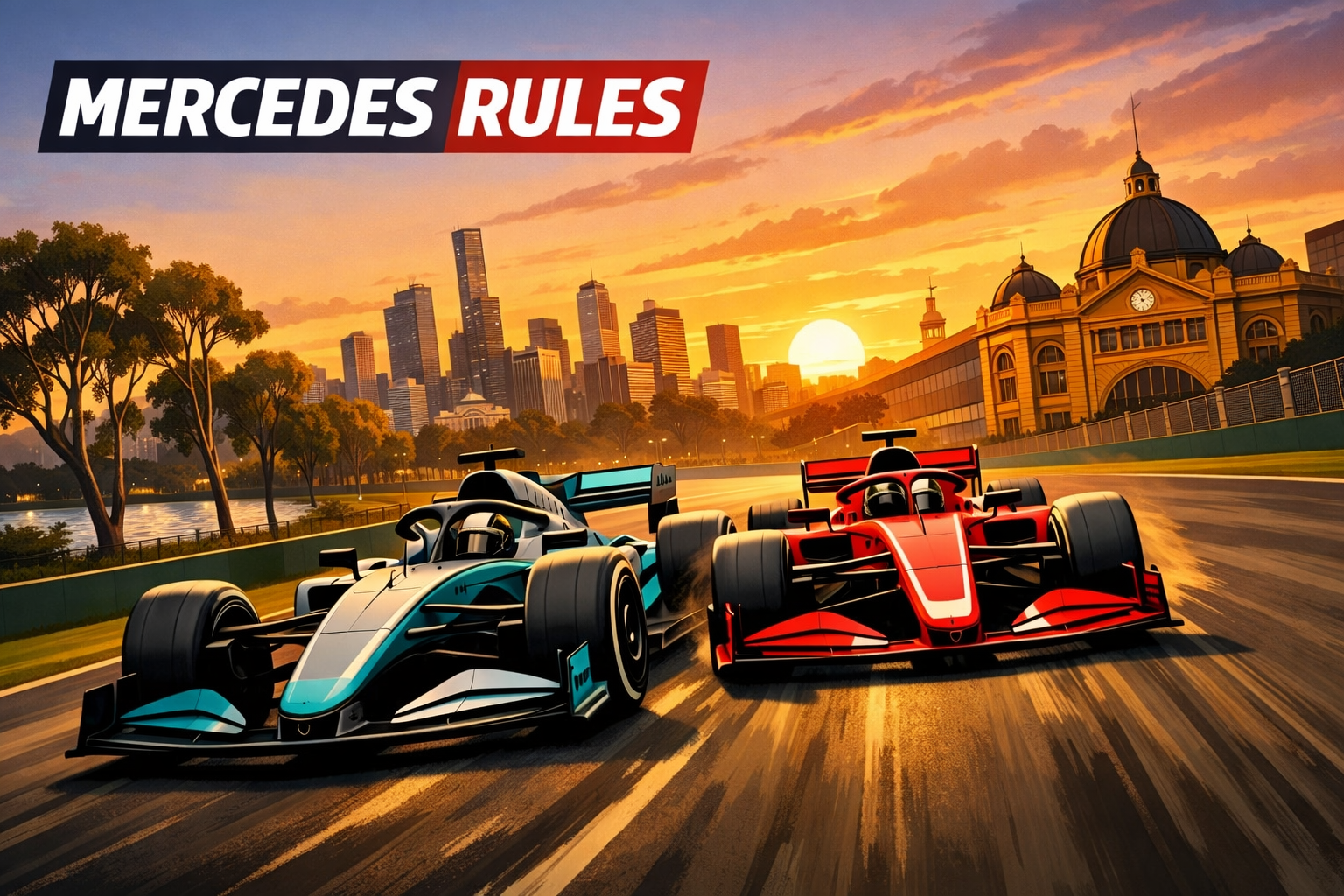

George Russell delivered a masterclass in strategic racing to claim victory at the 2026 Formula 1 Australian Grand Prix, leading teammate Kimi Antonelli home in a dominant Mercedes 1-2 finish that sent an emphatic statement to every rival on the grid: the Silver Arrows have arrived in the new era ready to dominate.
2026 Australian Grand Prix Overview
The 2026 season-opening Australian Grand Prix at Albert Park, Melbourne, delivered everything a Formula 1 fan could want from a curtain-raiser: drama, chaos, controversy and a result that will shape the narrative of the entire season ahead.
In front of a packed Melbourne crowd, George Russell converted pole position into a controlled and composed victory, resisting fierce early pressure from Ferrari’s Charles Leclerc before Mercedes executed a strategic masterstroke in the pit stops to seal the win. Behind Russell, rookie Kimi Antonelli held his nerve brilliantly to secure second place, completing a historic Silver Arrows 1-2 on the very first race weekend of Formula 1’s most radical new era.
Leclerc took third for Ferrari ahead of Lewis Hamilton in fourth, while reigning World Champion Lando Norris could only manage fifth for McLaren after a weekend that raised serious questions about where the Papaya team stands in the new technical landscape. Max Verstappen, meanwhile, delivered one of the drives of the race. charging from last on the grid all the way to sixth. but his weekend had been derailed long before Sunday afternoon.
Welcome to Formula 1 in 2026. It is louder, faster, more complex and more controversial than anything the sport has produced before. And it is only just getting started.
A New Era of Formula 1: The 2026 Regulations Explained
To fully appreciate what unfolded at Albert Park, it is essential to understand just how dramatically Formula 1 has transformed for 2026. This is not a minor tweak to an existing ruleset. it is a ground-up redesign of almost every element of the cars, from the power units to the aerodynamics, the tyres to the fuel.
The new 2026 cars are smaller, narrower and significantly lighter than their predecessors. The wheelbase has been shortened by 200mm, the car width reduced by 100mm and the minimum weight cut by 30kg. producing a machine that is noticeably more agile and responsive on track. The Pirelli tyres are also narrower at both ends, further reducing drag and trimming weight from the overall package.
The most significant revolution, however, lies in the power unit. For the first time in Formula 1 history, the cars operate on a near 50/50 split between internal combustion and electrical power. Battery output has been increased by almost 300 percent compared to the previous generation and the controversial MGU-H system has been deleted entirely. replaced by a vastly more powerful MGU-K that delivers instant, ferocious electrical torque. The cars run on 100 percent advanced sustainable fuel, underlining Formula 1’s commitment to reaching net zero carbon by 2030.
DRS. the drag reduction system that has defined overtaking for over a decade. is also gone. In its place is Active Aerodynamics: moveable front and rear wing elements that automatically adjust between Corner Mode and Straight Mode depending on where the car is on circuit. On the straights, the wings flatten to reduce drag and boost top speed. In the corners, they close to maximise downforce and grip. And when a driver gets within one second of the car ahead, they gain access to Overtake Mode. a burst of additional electrical power designed to replicate and improve upon what DRS once offered.
Five manufacturers now supply power units to the grid: Mercedes, Ferrari, Red Bull Powertrains in partnership with Ford, Honda supplying Aston Martin and the all-new Audi works outfit running their own in-house engine. The manufacturer war has never been more intense. and the 2026 Australian Grand Prix was the first real test of who got it right.
Practice Sessions: A Weekend of Discovery
Practice at Albert Park was unlike anything teams had experienced in recent years. With every outfit learning their new machinery in real race conditions for the first time, the three sessions produced a rotating cast of fastest lap holders as teams cycled through low-fuel runs, long stints and system validation checks in equal measure.
Mercedes looked composed and methodical throughout, consistently placing both Russell and Antonelli near the front of the timing sheets while logging impressive mileage. Ferrari showed genuine pace in the long runs, with Leclerc and Hamilton appearing comfortable in the new machinery despite the significant technical step-change from 2025. McLaren were present but not dominant, while Red Bull endured a far more difficult weekend than anyone in the camp would have anticipated heading into the season opener.
The midfield picture was equally intriguing. Audi made their full works debut as a manufacturer, with Gabriel Bortoleto and Nico Hülkenberg focusing almost entirely on reliability and system checks rather than lap time. Cadillac. Formula 1’s brand new eleventh team. turned heads simply by being there, with Sergio Pérez and Valtteri Bottas completing laps and learning the circuits under the new technical package.
Qualifying: Russell on Pole, Verstappen Crashes Out
Saturday qualifying delivered the first major shock of the 2026 season. George Russell was serene and measured throughout, ultimately claiming pole position for Mercedes ahead of teammate Antonelli. a front-row lockout that confirmed the Silver Arrows’ status as the team to beat heading into Sunday.
But the headline of qualifying was not who topped the times. it was who failed to make it out of Q1. Max Verstappen, the four-time World Champion and one of the pre-season title favourites, spun into the barriers during the opening qualifying session and was eliminated before Q2 had even begun. It was a stunning outcome. one that would have been almost unthinkable under the previous generation of regulations. and it illustrated in stark, dramatic fashion just how unpredictable this new era of Formula 1 is going to be.
Ferrari locked out the second row of the grid with Leclerc third and Hamilton fourth, while Norris qualified fifth for McLaren. Further back, the midfield was tightly packed, with small margins separating a wide range of teams on a circuit and in conditions that nobody truly had a complete handle on.
Race Day Chaos: Piastri Out Before the Start
If Saturday’s qualifying had been dramatic, Sunday morning delivered a gut punch to the home crowd even before a single racing lap had been completed. Oscar Piastri, the Australian fan favourite and one of the most exciting young talents in the sport, clipped the kerb at Turn 4 on his out-lap to the grid, damaging his McLaren beyond immediate repair and ending his 2026 season opener before it had even started.
The scenes at Albert Park were painful. Piastri’s home crowd, who had arrived in enormous numbers hoping to cheer on their local hero in the first race of a thrilling new era, watched helplessly as the McLaren was wheeled back to the garage. It was the kind of cruel, random misfortune that Formula 1 occasionally delivers. and it will have stung Piastri and the McLaren team deeply given the context of the weekend.
With Piastri out and Verstappen starting from the back, the race began with two of the championship’s most anticipated storylines already disrupted before the formation lap was complete.
The Race: Russell vs Leclerc, Strategy Decides It All
When the lights went out at Albert Park, the 2026 Australian Grand Prix delivered the kind of electrifying opening laps that the new regulations had promised. and the first few corners set the tone for everything that followed.
Leclerc made a ferocious start from third on the grid, surging ahead of Antonelli and seizing the lead from Russell in the opening corners. What followed was one of the most visually spectacular battles Melbourne has seen in years. the two lead cars swapping positions repeatedly over the opening phase of the race, powered by the new Active Aerodynamics and Overtake Mode system that created wild swings in relative performance down the pit straight and into the first braking zone.
The new power unit dynamics were on full display. With both cars running different electrical deployment profiles, the delta in straight-line speed between the Mercedes and the Ferrari shifted lap by lap, producing the extraordinary sight of Russell and Leclerc exchanging the lead seven times across just nine laps. It was spectacular. and entirely new. Formula 1 had never seen anything quite like it.
But as dramatic as the on-track battle was, the race was ultimately decided in the pit lane. When a Virtual Safety Car period was triggered by Red Bull’s Isack Hadjar pulling off the circuit with a mechanical failure, Mercedes reacted instantly. pitting both Russell and Antonelli for fresh tyres under the reduced speed period. Ferrari, assessing their options on the pit wall, chose to stay out with both Leclerc and Hamilton, gambling on track position and tyre longevity to see them through to the finish.
It was a gamble that did not pay off. A second Virtual Safety Car period. triggered by the retirement of Cadillac’s Valtteri Bottas. came too late to help the Scuderia. By the time both phases had elapsed and the race resumed at full speed, Russell was in control at the front, managing pace and gap with the clinical assurance of a driver who knew the victory was firmly within his grasp.
Antonelli held steady in second, Leclerc came home third and Hamilton rounded out the top four. Further back, Norris recovered to fifth and Verstappen delivered a remarkable charge through the field to sixth. a result that, under any other circumstances, would have been celebrated as an outstanding recovery drive. In Melbourne 2026, it felt like a warning shot.
Drivers React: Love It or Hate It, the New Formula 1 Divides Opinion
After the chequered flag fell over Albert Park, the paddock offered a fascinatingly divided verdict on the new 2026 regulations. and the debate shows no sign of cooling down heading into round two in China.
Russell was unambiguous in his praise for the new era, describing the race as genuinely fun to drive and the car as an exciting new challenge, with real wheel-to-wheel battling producing the kind of close racing he and many fans had been hoping for from the regulatory reset.
Norris was considerably less enthusiastic. The reigning World Champion described the new Overtake Mode as chaotic, warning that a serious accident was inevitable if the system remained unchanged and expressing frustration at the unpredictable nature of the electrical deployment swings that left drivers unable to defend or attack in any conventional sense.
Verstappen, who has been a vocal critic of the new regulations since their announcement in 2022, did not soften his position after Melbourne. The Dutchman called the racing “chaos” and made clear his view that Formula 1’s governing bodies need to act quickly to address the issues that drivers are experiencing, warning that the sport risks damaging its reputation if the concerns go unaddressed.
Meanwhile, Fernando Alonso expressed serious safety concerns about the behaviour of the cars on the opening lap when multiple drivers trigger Overtake Mode simultaneously on the back straight, describing the sensation as sketchy and unpredictable in a way that goes beyond normal Formula 1 risk. These are not the kinds of comments that Formula 1’s technical leadership will take lightly.
The New Teams: Audi and Cadillac Make History
Amid all the drama at the front of the grid, two of the most significant storylines of the entire Melbourne weekend had nothing to do with the podium.
Cadillac completed their maiden Formula 1 race. a landmark moment not just for the American manufacturer, but for the sport as a whole. Pérez and Bottas both took the chequered flag and while their finishing positions were towards the rear of the field, the fact that Cadillac completed their very first Grand Prix without incident was a result to genuinely celebrate for a team that only joined the grid this season.
Audi’s debut as a full works constructor was similarly historic. Gabriel Bortoleto crossed the line in ninth. a remarkable result on the German manufacturer’s first day of competitive Formula 1 racing. and the Audi camp departed Melbourne with genuine optimism about the foundation they have built ahead of the long development race that lies ahead.
Formula 1 now has eleven teams for the first time since 2016. The grid has never been deeper, the competition never broader and the potential storylines across a twenty-four race season never more numerous.
If you want a deeper look at how Cadillac have settled into life as an F1 team, The Cadillac Verdict: Six Races In, What Have We Learned? breaks down exactly what the American outfit have learned since Melbourne.
2026 Drivers’ Championship Standings After Round 1
After the dust settled at Albert Park, the early championship standings painted a clear but certainly not permanent picture of where the power lies at the start of the 2026 season.
| Position | Driver | Team | Points |
|---|---|---|---|
| 1st | George Russell | Mercedes | 25 |
| 2nd | Kimi Antonelli | Mercedes | 18 |
| 3rd | Charles Leclerc | Ferrari | 15 |
| 4th | Lewis Hamilton | Ferrari | 12 |
| 5th | Lando Norris | McLaren | 10 |
| 6th | Max Verstappen | Red Bull | 8 |
Mercedes lead both the Drivers’ and Constructors’ Championships. Ferrari sit second in both. McLaren. the reigning champions. are already on the back foot. History suggests that opening-round results under major regulation changes rarely tell the full story and the development race across the remaining twenty-three rounds of the season will reshape this picture significantly. But first impressions matter in Formula 1 and right now, the Silver Arrows look very strong indeed.
What Comes Next: Chinese Grand Prix and the First Sprint Weekend
Formula 1 moves swiftly from Melbourne to Shanghai, where the Chinese Grand Prix hosts the first Sprint Weekend of the 2026 season. China has been adjusted for the expanded eleven-team grid, with six cars now eliminated in each of the first two Sprint Qualifying sessions rather than five. a small but meaningful tweak that keeps the format competitive and relevant across the wider field.
The Chinese Grand Prix will be the first genuine test of whether the new 2026 regulations produce consistent racing across a variety of circuit types. Shanghai’s long straights and heavy braking zones will provide a very different challenge to Albert Park’s flowing medium-speed layout and teams will be working frantically through the short turnaround to extract every tenth of performance from their data before the lights go out again.
For Mercedes, the objective is simple: carry the momentum. For Ferrari, it is to convert their raw pace into a strategic result. For McLaren, it is to understand quickly what went wrong in Melbourne and find the development path that returns them to the front. And for Verstappen and Red Bull, it is to show that the events of Albert Park were an anomaly rather than a sign of something more concerning.
The 2026 Formula 1 season has only just begun, yet it has already delivered more drama, more debate and more genuine uncertainty than any season opener in living memory. George Russell and Mercedes have made the perfect start. but in this extraordinary new era of Formula 1, nothing is settled, nothing is guaranteed and everything is still to race for.
Follow RukiF1 for full coverage of every race weekend throughout the 2026 Formula 1 season, including race reports, technical analysis, driver ratings, team news and the latest updates from the paddock as this thrilling new chapter of the sport continues to unfold.
The Mercedes Parallel: When Regulation Resets Change Everything
This result will draw obvious comparisons to 2014. That was the last time a regulation overhaul handed one team a dominant advantage from race one. Mercedes won fifteen of nineteen races that year and never looked back. The 2026 picture is different in some ways. Ferrari are genuinely close. Red Bull have Verstappen. But the structural advantage Mercedes appear to have built into their power unit architecture is the kind of thing that takes rivals a full season to properly close down.
History offers one other instructive parallel. In 2009, a team that had spent months on the brink of collapse emerged from a regulation reset with a car nobody else could touch. The Brawn GP story showed exactly what happens when one team reads a new rulebook better than everyone else. Mercedes in 2026 have far more resources than Brawn ever did. That should worry the rest of the grid considerably.
The driver market will also be worth watching as the season develops. Several seats remain uncertain beyond 2026 and a dominant Mercedes makes Russell’s position look very secure indeed. For the full picture on where out-of-contract drivers might land, our breakdown of F1’s 2026 free agents covers every major name on the market.
Key Takeaways
- George Russell and Mercedes executed a near-perfect weekend: pole position, a strategic VSC call that won the race and a 1-2 finish on day one of the new era.
- The 2026 Active Aerodynamics and Overtake Mode system produced spectacular racing but divided the paddock sharply on safety grounds. The FIA will face pressure to act before the season develops further.
- Max Verstappen’s Q1 exit was the single most shocking result of the weekend. Red Bull’s power unit deficit looks real and significant at this early stage.
- Oscar Piastri’s pre-race retirement was the cruelest moment of the weekend. McLaren arrive in China needing answers on both reliability and outright pace.
- Cadillac and Audi both completed their debut races. Bortoleto’s ninth for Audi was a genuinely impressive result and one that signals the new manufacturer could develop quickly.
Frequently Asked Questions
Why did Mercedes dominate the 2026 Australian Grand Prix?
Mercedes appeared to have the strongest overall package from the first lap. Their power unit delivered superior electrical deployment management, their Active Aerodynamics system was well-calibrated for Albert Park’s layout and the team’s strategic call to pit both cars under the first Virtual Safety Car period was the decisive moment of the race. It was a complete performance across all departments.
What is Overtake Mode in the 2026 F1 regulations?
Overtake Mode is the 2026 replacement for DRS. When a driver gets within one second of the car ahead, they can activate a burst of additional electrical power from the MGU-K system. It’s designed to make overtaking possible without the artificial fixed-wing opening that DRS used. Several drivers raised safety concerns about its behaviour in Melbourne, particularly in multi-car situations on the main straight.
How did Max Verstappen end up starting last at the 2026 Australian Grand Prix?
Verstappen spun into the barriers during Q1 on Saturday, eliminating him from qualifying before the session had properly developed. He started from the back of the eleven-team grid on Sunday. His recovery drive to sixth was impressive but the underlying pace deficit of the Red Bull package was clear throughout the weekend and will be a major concern heading into China.
Who are the new teams on the 2026 F1 grid?
Two new outfits joined Formula 1 for 2026. Cadillac entered as the eleventh team, running Sergio Pérez and Valtteri Bottas and completed their maiden race in Melbourne. Audi joined as a full works constructor with Gabriel Bortoleto and Nico Hülkenberg. Bortoleto finished ninth on debut, which was a strong result for a brand new manufacturer in their very first competitive outing.
What happened to Oscar Piastri at the 2026 Australian Grand Prix?
Piastri clipped a kerb at Turn 4 during his out-lap to the grid on race morning, damaging his McLaren badly enough that the team could not repair it in time for the start. He was classified as a non-starter. It was a devastating outcome for the Australian driver in front of his home crowd and left McLaren with only Norris to score points on a difficult weekend for the reigning constructors’ champions.
