NEXT RACE
Loading…
starts in
—
Your Time
Track Time
local time
Charles Leclerc claimed victory at the 2026 British Grand Prix, the ninth round of the season, converting a P2 start into a race win at Silverstone on 5 July. The podium was completed by George Russell in second and Lewis Hamilton in third, giving Ferrari and Mercedes two cars apiece in the top four. Pole-sitter Andrea Kimi Antonelli could not convert his front-row advantage into a win but did set the fastest lap of the race — 1:31.777 — to salvage a measure of personal glory. The afternoon was not without attrition: Max Verstappen, Alexander Albon, and Nico Hülkenberg all failed to see the chequered flag, retiring after 46, 43, and 36 laps respectively.
Silverstone Circuit is a motorsport venue in Northamptonshire, approximately 90 kilometers northwest of London. Built on the site of a former Royal Air Force bomber station from World War II, the circuit first opened in 1948 and has since become one of the most prestigious racing facilities in the world. It has been home to the British Grand Prix since the inaugural Formula 1 World Championship race in 1950, playing a pivotal role in shaping the history and culture of grand prix racing.
Throughout its seven-decade history, Silverstone has undergone numerous layout changes and significant facility upgrades. The track has been modified several times to improve safety standards, enhance overtaking opportunities, and adapt to the evolving demands of modern Formula 1 machinery. Major redevelopments have included the construction of the Arena complex in 2010 and extensive facility improvements in recent years, encompassing a new pit complex, paddock facilities, and spectator amenities. Despite these modernizations, Silverstone has preserved the raw, challenging character that has made it a favorite among drivers and teams.
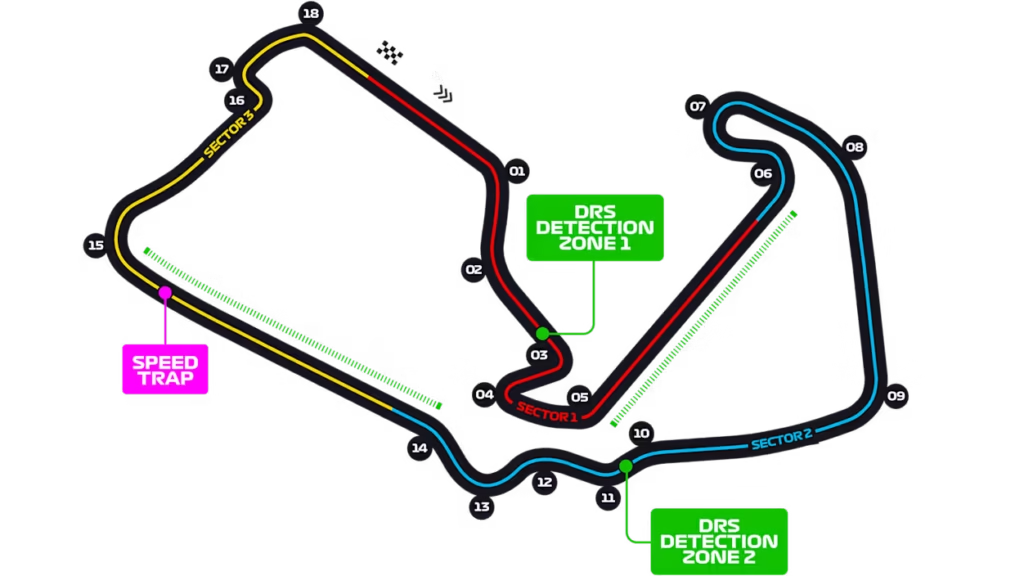
The modern Silverstone Grand Prix layout stretches 5.891 kilometers and features 18 corners that test every facet of a racing car’s performance and a driver’s skill. The circuit runs in a clockwise direction and combines long, sweeping curves with tight technical sections, creating a challenge that rewards both outright speed and precision handling. High-speed straights such as the Hangar Straight and Wellington Straight provide opportunities for slipstreaming and overtaking, while the various corner complexes demand different setup compromises from the teams.
The circuit begins with the Abbey chicane, followed by Farm Curve and the Village corner complex. It continues with the tight Stowe corner, which leads onto the long Hangar Straight where cars reach their maximum velocity before heavy braking into the Arena complex. The Wellington Straight then propels cars toward Brooklands, a heavy braking zone that often produces overtaking opportunities. The lap concludes with the Luffield-Woodcote section, a technical sequence that places emphasis on traction and mechanical grip as drivers prepare to launch onto the start-finish straight.
The Maggotts-Becketts-Chapel sequence is the defining feature of Silverstone. This series of high-speed directional changes is taken at speeds exceeding 270 kilometers per hour, making it one of the most exhilarating and challenging sections in Formula 1. Drivers must maintain absolute precision through these sweeping esses while managing aerodynamic balance at the limit of adhesion.
The Village corner complex, reached immediately after Farm Curve at the start of the lap, is an incredibly fast section that demands maximum aerodynamic efficiency and mechanical grip. Stowe corner, which follows the Maggotts-Becketts-Chapel sequence, is a tight turn that feeds cars onto the Hangar Straight and requires precise braking and rotation. Brooklands, at the end of the Wellington Straight, is a heavy braking zone that regularly generates overtaking opportunities. The Luffield-Woodcote section closes the lap with a technical sequence where traction and mechanical grip are at a premium.
Silverstone is renowned for its fast and flowing nature. The circuit’s high-speed corners demand maximum aerodynamic efficiency, mechanical grip, and commitment from drivers, while its layout requires teams to find the optimal balance between high-speed aerodynamic performance and low-speed mechanical grip. Each corner has its own unique character and challenge.
The atmosphere during a British Grand Prix weekend is distinctive, with the expansive viewing areas allowing spectators to witness cars attacking multiple corners from a single vantage point. The natural amphitheater-like terrain provides excellent sightlines throughout the facility. The British fans’ knowledge and appreciation of racing produces an environment of genuine sporting enthusiasm, directed at exceptional performances from drivers of all nationalities. This combination of a challenging circuit layout, world-class facilities, and engaged supporters has established Silverstone as one of Formula 1’s most significant venues on the calendar.
Formula 1 British Grand Prix 2026 (Great Britain (Silverstone)) race weekend · full race calendar · F1 drivers
A lap of the Silverstone Grand Prix circuit measures 5.891 kilometers. The full race distance over the British Grand Prix weekend is 306.198 kilometers.
The Silverstone Grand Prix layout features 18 corners. These range from high-speed sweeping curves to tight technical sections, creating a varied challenge for drivers and teams.
Silverstone hosted its first Formula 1 World Championship race in 1950, making it the venue for the inaugural round of the F1 World Championship. The circuit itself first opened in 1948.
The lap record at Silverstone is 1:27.097, set in 2020.
Silverstone is a clockwise circuit.
Silverstone has two DRS zones. The circuit’s long straights, including the Hangar Straight and Wellington Straight, provide the conditions for these overtaking-aid zones.
Silverstone is located in Northamptonshire, England, approximately 90 kilometers northwest of London.
The land on which Silverstone Circuit stands was formerly a Royal Air Force bomber station during World War II. The circuit was built on this site and first opened in 1948.
Maggotts-Becketts-Chapel is a series of high-speed directional changes at Silverstone, taken at speeds exceeding 270 kilometers per hour. It is widely regarded as one of the most challenging and exhilarating sections in Formula 1, requiring drivers to maintain precision through sweeping esses at the limit of aerodynamic adhesion.
The most recent British Grand Prix at Silverstone was the 2026 edition, won by Charles Leclerc driving for Ferrari. He converted a P2 start into victory on 5 July, with George Russell and Lewis Hamilton completing the podium.
Silverstone has undergone several major redevelopments over its history, including the construction of the Arena complex in 2010. More recent improvements have included a new pit complex, updated paddock facilities, and enhanced spectator amenities.
The Hangar Straight and the Wellington Straight are the two principal straights at Silverstone where cars reach high speeds and overtaking opportunities arise. The Wellington Straight leads into Brooklands, a recognized heavy braking zone where passing moves frequently occur.